
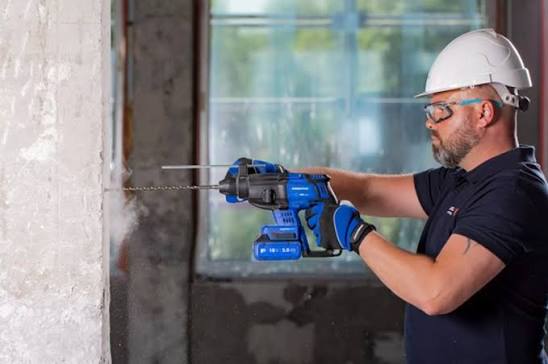
When a job demands drilling through reinforced concrete, breaking out masonry, or installing anchors across a structural surface, the tool selection determines how efficiently the work gets done. The rotary hammer category has developed considerably, offering professionals a range of formats, power outputs, and feature sets that make it both an exciting and complex purchasing decision. This guide cuts through the complexity to highlight what genuinely matters.SDS drills carry this concept further through the slotted drive system built into the chuck.
The Engineering That Sets These Tools Apart
At the foundation of every rotary hammer drill is a mechanism that separates rotary motion from hammer action. Unlike standard drills, where the chuck transfers rotational force directly to the bit, a rotary hammer generates its hammer impulse through an independent pneumatic or electro-mechanical system. The result is a striking force that operates parallel to the rotation, driving the bit into the material with each revolution.
The bit slots into the chuck rather than being clamped in place, allowing it to move independently along its axis during the hammering cycle. This freedom of movement is what makes the impact so effective—the bit strikes the material cleanly with each pulse rather than having its motion dampened by chuck resistance.
SDS-Plus vs. SDS-Max: Understanding What Each Format Delivers
SDS-Plus
The SDS-Plus format is the most widely adopted rotary hammer specification in professional construction. Its design is appropriate for the majority of drilling tasks encountered in residential and commercial settings: anchor installation in brick and block, cabling penetrations through standard concrete walls, and general masonry work requiring holes up to a medium diameter.
The practical appeal of SDS-Plus extends beyond performance. Tools in this format are manageable in confined spaces, light enough for overhead use, and supported by an extensive range of compatible accessories. For tradespeople whose work spans a variety of surfaces and hole sizes, SDS-Plus provides the versatility needed without unnecessary excess.
SDS-Max
SDS-Max is the format specified when the application involves structural concrete, thick slabs, or large-diameter drilling. The wider shank diameter of SDS-Max bits allows more impact energy to be transferred from tool to bit, and from bit to material. This increased energy per stroke makes SDS-Max tools significantly faster through dense aggregate and reinforced concrete than SDS-Plus alternatives operating in the same conditions.
The tradeoff is size and weight. SDS-Max machines are substantially heavier, and the increased impact energy they generate also produces more vibration for the operator to manage. For the applications they are built for, these characteristics are acceptable. Using them on lighter tasks, however, is counterproductive—an oversized tool in the wrong context creates unnecessary fatigue without improving results.
Key Specifications to Compare When Evaluating Models
Impact Energy
Impact energy is the specification that most directly predicts a rotary hammer’s performance in hard materials. A higher impact energy rating translates to more force per hammer stroke, which means faster penetration, cleaner holes, and reduced strain on the bit. When comparing tools, use impact energy as the primary benchmark for heavy-duty capability.
Rotation Speed and Variable Speed Control
Rotation speed influences how efficiently the bit clears material from the hole between each hammer stroke. Tools with variable speed allow the operator to start slowly—reducing the risk of wandering on initial contact—before building to full drilling speed once the bit has established a path. This control is particularly important when drilling near edges, in fragile materials, or on surfaces where precision matters.
Operating Modes
Rotary hammer drills typically offer three operating modes: rotation only, hammer and rotation combined, and hammer only for chiseling. The combination mode is used for the majority of drilling tasks. Hammer-only mode activates when the tool is being used for light demolition, tile removal, or surface preparation with an appropriate chisel attachment. A tool that offers all three modes provides considerably more utility across a wider range of job site requirements.
Managing Vibration in Professional Use
Vibration exposure is an occupational health matter that deserves serious attention. Prolonged use of rotary hammer drills without adequate vibration control contributes to hand-arm vibration syndrome over time, a condition that affects grip strength, sensation, and fine motor control.
Professional-grade rotary hammers incorporate active vibration reduction systems that mechanically isolate the handle from the main body of the tool during the hammering cycle. The practical effect is that the operator feels less of the impact energy that is directed into the material, reducing fatigue during long working sessions and lowering cumulative exposure over the course of regular use.
When evaluating tools for regular professional use, the presence and quality of vibration damping technology should factor prominently into the decision—not just for comfort, but for long-term health protection.
Corded or Cordless: Making the Right Call
What Corded Tools Offer
A corded rotary hammer delivers continuous, consistent power without the interruption of battery management. For high-volume drilling tasks—running a pattern of anchor holes across a concrete floor, for instance—a corded tool maintains its output level from the beginning of the task to the end. There is no energy curve, no waiting for a battery to cool before continuing, and no upper limit on how long the tool can run.
Where Cordless Tools Shine
Modern cordless rotary hammers powered by high-capacity battery platforms now perform at a level that makes them viable for the majority of professional drilling applications. The operational freedom they provide—the ability to work in locations without power access, to move without trailing cables, and to transition between tasks on a large site without repositioning extension leads—is a meaningful productivity advantage.
Choosing between formats comes down to how the tool will be used. Professionals who work on large sites with limited power access, or who value the flexibility of a cable-free setup, will typically find cordless tools more practical. Those working in fixed locations on power-intensive tasks may continue to favor corded reliability.
Making a Decision That Serves Your Work Long-Term
The most effective way to approach this purchase is to work backward from the application. Define the hardest material you regularly drill, the largest diameter hole your work requires, and how long the tool typically operates in a single session. Those three factors will narrow the format, impact energy range, and power source that are genuinely right for your situation.
A rotary hammer drill purchased with that clarity performs better, lasts longer, and represents a more sound investment than one selected on the basis of specification numbers alone.