

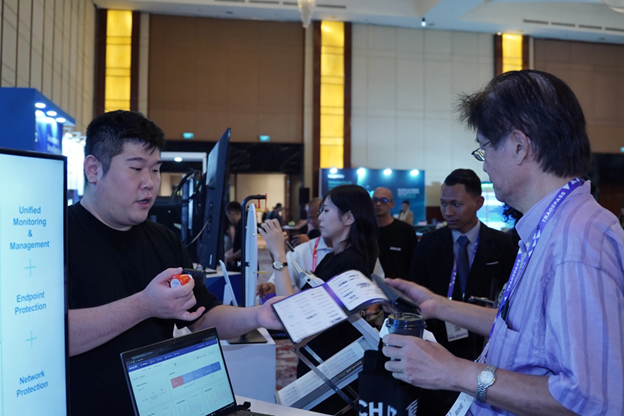
Exchange of knowledge during international technology conferences has already become a vital part of those organizations that want to enhance digital security approaches. Interviews conducted during a cybersecurity industry summit are also a good source of information on advanced security systems, enterprise security frameworks, and viable risk management approaches. These forums are attended by industry leaders, security professionals, and technology innovators who provide their expertise on protecting digital infrastructure and sensitive data. Organizations have access to exposure of real-world cybersecurity practice, which enhances resilience to high-level cyber attacks. The information exchanged in these events assists the enterprises to perfect their defense, enhance incident preparedness, and devise more proactive cybersecurity strategies throughout their digital ecosystems.
1. Advanced Threat Intelligence Integration
The issue of integrating threat intelligence has emerged as one of the most discussed issues among cybersecurity professionals at international technology conferences. According to professionals, to remain at the leading edge of the dynamic cyber threats, organizations have to constantly collect and process threat information provided by various sources.
Continuous Threat Monitoring: Security departments use highly developed monitoring systems which monitor network traffic, system usage and user actions. These surveillance systems assist in the detection of anomalies and any suspicious patterns before they develop into a major security incident. Constant observation also enables organizations to have transparency throughout their digital infrastructure.
Global Intelligence Data Sharing: Studies conducted by research institutions and security communities may be some of the international sources of data gathered by threat intelligence platforms. Through this information sharing, organizations have a wider perspective of new threats and methods of attacks. This co-operation strategy enhances defensive strategies in industries.
Correlation of Security Data: Current-day security platforms combine the data provided by firewalls, endpoint protection software, and security analytics platforms. A comparison of this data assists in determining some previously undetected patterns of attack and increases the effectiveness of detection of the threats, a notion commonly discussed at a cybersecurity industry summit in the form of consolidated security infrastructures.
2. Strengthening Zero-Trust Security Frameworks
The concept of adopting zero-trust systems to enhance cybersecurity infrastructure in enterprises is often discussed among security leaders. The fundamental concept of zero-trust security is the fact that there is no user or device that should be trusted automatically, regardless of where it is located in the network.
Identity Verification Systems: Identity verification technology, like multi-factor authentication and biometric validation, is key to zero-trust environments. The tools will guarantee that sensitive resources are accessible to only authorized users. Such a strategy will greatly decrease the chance of unauthorized access.
Continuous Authentication Processes: Zero-trust systems not only check access at the time of login, but also continuously monitor user behavior and interactions of their systems. Access privileges may be automatically limited in case a suspicious activity is detected. The continuous authentication will contribute to tighter control of security.
Device Security Validation: Zero-trust models are also able to assess the security position of the devices prior to network access. Systems also verify the updated software, security patches and endpoint protection mechanisms. Devices that do not pass such checks can be blocked to accessing important resources.
3. Strengthening Cloud Security Governance
Cloud infrastructure has emerged as one of the primary elements of enterprise technology infrastructures, rendering cloud security governance a critical topic of discussion among security professionals. Experts stress that organizations should have established clear policies and monitoring tools to make sure that cloud resources are not jeopardized or violate industry regulations.
Centralized Cloud Monitoring: Centralized monitoring tools are software used by organizations to ensure that they can see into cloud services, applications, and data storage systems. These tools aid security personnel to monitoring system activity and identifying suspicious activity in a distributed environment.
Access Control Management: The access management policies can make sure that only those resources that are necessary to carry out the tasks of the employees and partners are made accessible. Restricted access privileges minimize the harm that can be inflicted by breached accounts or insider threats.
Automated Compliance Monitoring: Modern cloud protection platforms have the potential to automatically process systems in accordance with the regulatory requirements. They produce compliance reports and notify administrators when policies are not met, which assists organizations in keeping regulatory preparedness.
4. Proactive Incident Response and Automation
The other valuable strategy addressed by security experts is to enhance incident response capacity via automation and formal response planning. Organizations should ensure that they can respond swiftly to cyber incidents to reduce their impact and ensure normalcy.
The insights provided in a cybersecurity networking conference may often serve as a demonstration of how automated response systems can greatly enhance the effectiveness and speed with which a threat is contained.
Automated Threat Containment: Automated systems will be able to isolate infected computers and limit malicious network access without the need to wait until humans can act. This speedy entrapment aids in preventing attackers to disseminating throughout enterprise networks.
Security Orchestration Platforms: Security orchestration tools incorporate various defensive platforms and organize response activities. With the coordination of security technologies, organizations are able to react to threats in a more effective manner, in addition to making operations more complex.
Incident Response Playbooks: Structured response processes are used to guide security teams through a set of actions during various forms of cyber incidents. Such playbooks enhance coordination and make sure that security teams adhere to the same response procedures.
Conclusion
The information presented by the strategies of various cybersecurity specialists at the international technology conferences proves that the present security needs not only technological advancement but also strong organizational-level practices. Integration of threat intelligence, zero-trust, cloud governance, and automated incident response systems is all capable of enhancing enterprise protective measures. Companies attending a cybersecurity networking conference will receive valuable insights that will ensure they become more resilient, safeguard online assets, and effectively respond to new threats.
An event like IndoSec helps to bring the leaders, the enterprise professionals and the technology innovators together so that they can discuss the advanced security strategies and solutions. In its sessions, which are guided by experts, and in its collaborative work with organizations, IndoSec provides organizations with knowledge that can help them increase their cybersecurity posture. Based on the insights left in these platforms, companies can enhance their risk management procedures, the safety of key infrastructure, and trust in their online space.